For many manufacturing companies, spreadsheets are the starting point for everything from inventory tracking to production planning and Bill of Materials (BOM) costing. They are familiar, flexible, inexpensive, and easy to customize.
But as a manufacturing business grows, the same spreadsheet that once made BOM costing simple can become a major source of cost inaccuracies, delays, and operational risk.
BOM costing at scale is not simply about adding up the cost of raw materials. It involves managing multiple components, suppliers, quantities, revisions, labor, overheads, scrap, currencies, and constantly changing prices. When this information is managed through spreadsheets, complexity quickly exceeds what manual processes can reliably handle.
Here’s why spreadsheet-based BOM costing starts breaking down as manufacturing operations scale.
1. BOM Complexity Grows Exponentially
A simple product may have a BOM containing a few dozen components. But complex manufactured products can contain hundreds or even thousands of parts, subassemblies, and materials.
As product lines expand, manufacturers may also maintain:
- Multiple BOMs for different products
- Engineering and manufacturing BOMs
- Regional or customer-specific variants
- Different production versions
- Substitute components
- Multiple levels of subassemblies
- Different scrap and yield assumptions
Managing this complexity in spreadsheets requires extensive formulas, linked files, and manual updates.
One incorrect cell reference or outdated formula can affect the calculated cost of an entire product. The larger the BOM structure becomes, the harder it is to identify where the error originated.
2. Material Prices Change Constantly
Raw material and component prices rarely remain static.
Steel, aluminum, plastics, electronic components, packaging materials, and other inputs can fluctuate based on supplier pricing, market conditions, transportation costs, exchange rates, and availability.
In a spreadsheet-driven process, updating BOM costs often means manually replacing prices across multiple files.
This creates a critical question: Which price is the correct price?
Is it the latest supplier quote? The last purchase price? The contracted price? The average purchase price? A negotiated price for a specific production quantity?
Without centralized costing rules and real-time data, different teams can easily work with different assumptions.
A sales team may quote a customer using one component cost while procurement is working with another. Finance may then calculate margins using a third figure.
The result is inconsistent costing and unreliable margins.
3. Version Control Becomes a Nightmare
Manufacturing products evolve.
Engineering changes a component. Procurement changes a supplier. Production modifies a process. Quality replaces a material. Customers request a specification change.
Every change can affect the BOM and therefore the product cost.
Spreadsheets make version management particularly difficult because files are frequently copied, renamed, emailed, and stored in different folders.
You may end up with files such as:
Product_BOM_Final.xlsx
Product_BOM_Final_v2.xlsx
Product_BOM_Final_New.xlsx
Product_BOM_Final_Approved.xlsx
Which one contains the latest approved BOM?
More importantly, which cost was used when a particular customer order was quoted three months ago?
Without proper revision history and audit trails, answering these questions becomes unnecessarily difficult.
4. Manual Data Entry Creates Costing Errors
Spreadsheet-based BOM costing depends heavily on manual data entry.
Someone has to enter quantities, component prices, labor rates, scrap percentages, overhead rates, and other variables.
Every manual entry introduces the possibility of an error.
A misplaced decimal point, incorrect unit of measure, duplicate component, missing component, or outdated price can materially change the final product cost.
These errors are particularly dangerous because they may not be immediately visible.
A spreadsheet can produce a perfectly formatted cost sheet while the underlying calculation is completely wrong.
At low volumes, teams may catch these errors through manual review. At scale, reviewing thousands of BOM lines manually is neither efficient nor reliable.
5. Indirect Costs Are Difficult to Model
Material costs are only one part of manufacturing cost.
Accurate product costing may also require:
- Direct labor
- Machine time
- Setup time
- Energy consumption
- Factory overhead
- Quality costs
- Packaging
- Freight
- Scrap and rework
- Outsourced operations
Spreadsheets can technically calculate these costs, but maintaining the required formulas and assumptions becomes increasingly complicated.
Different products may consume different machine capacities or require different labor processes. Overhead allocation may also vary by plant, production line, or product category.
As these rules multiply, spreadsheets become increasingly difficult to maintain and validate.
6. Spreadsheets Struggle With Real-Time Collaboration
Modern manufacturing organizations rarely operate from a single location.
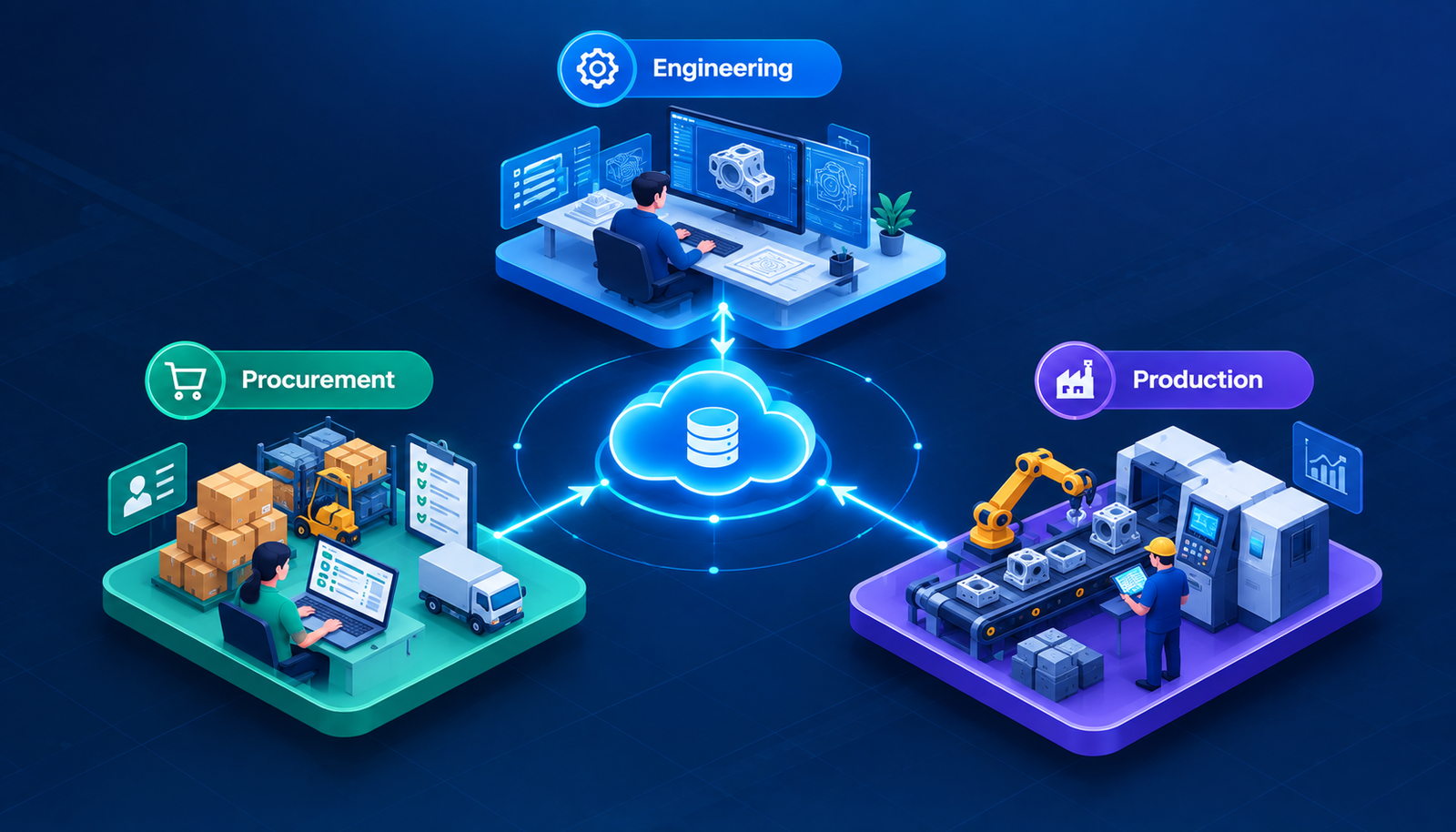
Procurement may work from one office, engineering from another, production from the factory floor, and finance from a central corporate team.
When BOM costing lives in spreadsheets, collaboration often means sending files back and forth or maintaining shared workbooks.
This creates several problems:
- Multiple people editing different versions
- Changes being overwritten
- Data synchronization delays
- Limited visibility into who changed what
- Difficulty maintaining a single source of truth
Even cloud-based spreadsheets solve only part of the problem. They improve collaboration but do not automatically provide the structured BOM, revision, costing, approval, and audit controls that manufacturing requires.
7. Costing Becomes Slow as the Business Grows
A spreadsheet may calculate a small BOM almost instantly.
But when manufacturers have thousands of products, complex multi-level BOMs, frequent price changes, and multiple manufacturing locations, costing cycles can become increasingly time-consuming.
Teams may spend days preparing updated product costs.
This becomes a serious business problem when management needs answers to questions such as:
What will this product cost if material prices increase by 10%?
What happens to margin if the supplier changes its price?
How much can we save by replacing this component?
Which products are no longer profitable?
If answering these questions requires manually updating spreadsheets, decision-making slows down precisely when the business needs greater agility.
8. Scenario Analysis Is Extremely Difficult
Manufacturers frequently need to compare different costing scenarios.
For example:
- Current supplier vs. alternative supplier
- Local sourcing vs. imported components
- Different production volumes
- Different material grades
- Different labor rates
- Different scrap assumptions
Spreadsheets can create these scenarios, but each scenario often requires additional copies of files and formulas.
The more scenarios you create, the harder it becomes to ensure that all assumptions are consistent.
A dedicated costing system can instead allow manufacturers to change assumptions centrally and immediately evaluate their impact across products and BOMs.
9. Auditability and Governance Become Major Concerns
As companies grow, costing is no longer just an operational activity. It becomes a financial control.
Management needs confidence that reported product costs are accurate, consistent, and traceable.
Spreadsheets often provide limited answers to important governance questions:
- Who changed the BOM?
- When was the cost updated?
- Which supplier price was used?
- What was the previous cost?
- Who approved the change?
- Why did the product margin change?
Without a reliable audit trail, investigating costing discrepancies can become a time-consuming exercise.
The Real Problem: Spreadsheets Don’t Scale With Manufacturing Complexity
The issue isn’t that spreadsheets are inherently bad.
They are excellent tools for analysis, ad hoc calculations, and small-scale costing.
The problem occurs when manufacturers try to use them as the primary system for managing increasingly complex BOM costing processes.
At scale, manufacturers need a centralized costing environment that connects BOM structures with current material prices, supplier data, labor, overhead, manufacturing processes, revisions, and approvals.
Instead of asking, “Which spreadsheet has the latest cost?”, teams should be able to access a trusted, centralized product cost.
Instead of manually rebuilding costs whenever a component price changes, they should be able to automatically identify the products affected.
Instead of relying on individual experts to understand complex formulas, organizations should have standardized and transparent costing logic.
Moving Beyond Spreadsheet-Based BOM Costing
The transition away from spreadsheets doesn’t necessarily mean eliminating them completely.
Instead, manufacturers should define where spreadsheets add value and where they create risk.
Spreadsheets can remain useful for analysis and one-off calculations. But core BOM costing should increasingly be supported by systems designed for manufacturing complexity.
A scalable costing solution should provide centralized BOM management, version control, automated cost updates, multi-level BOM calculations, scenario analysis, approval workflows, and complete auditability.
Conclusion
Spreadsheet-based BOM costing works well when products, suppliers, costs, and production processes are relatively simple.
But manufacturing complexity grows rapidly with scale.
More products mean more BOMs. More suppliers mean more price changes. More engineering changes mean more revisions. More factories mean more costing variables. And more data means more opportunities for manual errors.
Eventually, the spreadsheet stops being a productivity tool and becomes a bottleneck.
For manufacturers looking to improve margins, accelerate quoting, control costs, and make faster decisions, moving BOM costing from fragmented spreadsheets to a structured, scalable costing process is no longer just an IT upgrade.
It is a strategic step toward better cost visibility and stronger manufacturing performance.