In today’s fast-paced digital landscape, mobile applications are no longer just optional extensions of businesses—they are critical drivers of customer engagement, brand loyalty, and revenue growth. As the competition intensifies and user expectations evolve, app developers and businesses must harness advanced tools to stay ahead. Among these tools, predictive analytics stands out as a game-changer.
By leveraging historical data and machine learning models, predictive analytics enables mobile app creators to anticipate user behavior, personalize experiences, and optimize performance. This blog dives into how predictive analytics works, why it’s essential, and the top strategies for using it to enhance mobile applications.
What is Predictive Analytics?
Predictive analytics refers to the use of data, statistical algorithms, and machine learning techniques to identify the likelihood of future outcomes based on historical data. In the context of mobile apps, it allows developers and product managers to forecast user behavior, detect patterns, and make data-driven decisions to improve user experience and app functionality.
This approach shifts mobile app development from reactive to proactive. Instead of waiting for user feedback or app issues to surface, predictive analytics empowers teams to anticipate needs and solve problems before they arise.
Why Predictive Analytics Matters for Mobile Apps
Mobile apps generate an immense volume of data—from user interactions and session durations to purchase histories and in-app behavior. However, raw data alone isn’t inherently valuable unless it’s interpreted effectively. This is where predictive analytics comes in.
Here are key reasons why predictive analytics is essential for mobile apps:
- Personalized User Experience: Apps can deliver content, offers, or functionalities tailored to individual user preferences.
- User Retention and Engagement: By predicting churn or engagement drops, apps can intervene with targeted campaigns or feature adjustments.
- Optimized Marketing Spend: Predictive models help identify high-value users, improving ad targeting and customer acquisition strategies.
- Revenue Growth: By forecasting in-app purchases and subscription likelihood, businesses can optimize monetization strategies.
- Efficient Product Development: Analytics can suggest which features are most likely to succeed, reducing the risk and cost of new development.
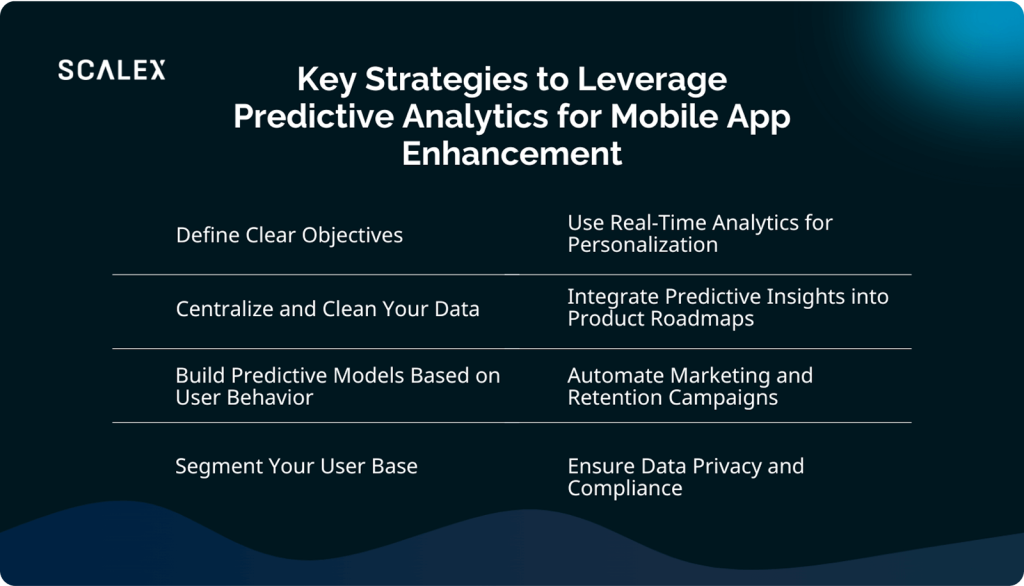
Key Strategies to Leverage Predictive Analytics for Mobile App Enhancement
To unlock the full potential of predictive analytics in mobile apps, developers and product teams must follow a strategic approach. Below are essential strategies to guide your implementation:
1. Define Clear Objectives
Before diving into analytics, it’s vital to define what you want to predict and why. Examples include:
- Will a user churn within the next 7 days?
- What is the next best action for a user?
- Which features lead to increased conversions?
Having clear goals ensures the models you build are relevant and actionable.
2. Centralize and Clean Your Data
Predictive accuracy is directly tied to data quality. Collect data from multiple touchpoints—user sessions, in-app purchases, social interactions, push notifications—and integrate them into a centralized data warehouse. Clean, standardized data allows machine learning algorithms to find meaningful patterns.
Best practices include:
- Removing outliers and anomalies
- Handling missing values
- Ensuring consistent formatting and labeling
3. Segment Your User Base
Not all users behave the same. Segmenting users based on behavior, demographics, engagement level, or lifecycle stage allows you to apply tailored predictive models. For instance:
- New users might need onboarding predictions
- Active users might benefit from upsell predictions
- Dormant users might require re-engagement strategies
Segmentation enhances the relevance and accuracy of your insights.
4. Build Predictive Models Based on User Behavior
Machine learning models such as regression analysis, decision trees, random forests, and neural networks can be used to build predictive models. Key use cases include:
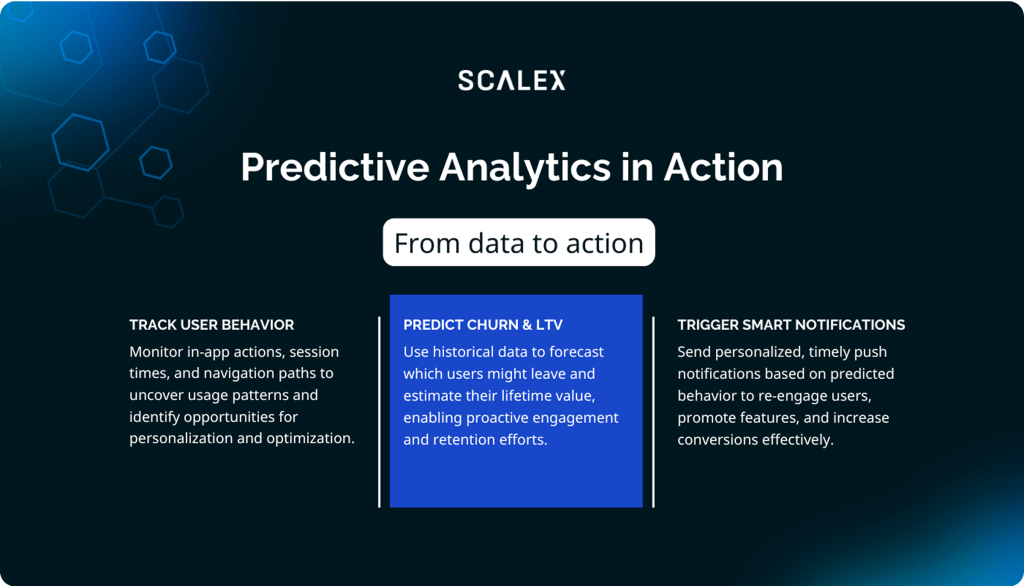
- Churn Prediction: Identify users likely to uninstall or stop using the app
- Lifetime Value Prediction: Forecast the total value a user will bring over their lifecycle
- Recommendation Engines: Suggest content, products, or features a user is most likely to engage with
The more granular and behavior-specific your models, the more impactful your strategies.
5. Use Real-Time Analytics for Personalization
Incorporate real-time predictive analytics to dynamically adapt app experiences. For example:
- Send personalized push notifications when a user is likely to convert
- Change UI components based on predicted behavior
- Adjust in-app promotions based on forecasted purchase intent
Real-time personalization enhances user satisfaction and drives meaningful engagement.
6. Integrate Predictive Insights into Product Roadmaps
Use predictive findings to prioritize your development efforts. If analytics indicate a feature correlates with higher user retention, move it up in the product roadmap. If a funnel step causes drop-offs, address it with UX/UI improvements or feature redesigns.
Predictive insights should inform A/B tests, UI decisions, and roadmap planning.
7. Automate Marketing and Retention Campaigns
Many mobile apps now use automated marketing platforms powered by predictive analytics. These platforms can:
- Automatically trigger campaigns for users at risk of churning
- Deliver targeted offers based on predicted interests
- Send re-engagement messages when user activity drops
This level of automation reduces manual effort and boosts marketing ROI.
8. Ensure Data Privacy and Compliance
As you collect and analyze user data, ensure compliance with regulations like GDPR, CCPA, and other local laws. Use anonymization techniques, obtain proper user consent, and provide opt-out mechanisms.
Responsible data practices not only ensure legal compliance but also build user trust.
Case Study: Predictive Analytics in Action
Example: Spotify
Spotify uses predictive analytics extensively to recommend music and podcasts tailored to individual users. By analyzing past listening behavior, skip patterns, and user preferences, Spotify delivers personalized playlists like “Discover Weekly” or “Daily Mix.” This level of personalization significantly boosts user engagement and retention.
Their predictive models also inform decisions on which new features to roll out and how to design UX flows for different user types.
Common Pitfalls to Avoid
While predictive analytics offers numerous benefits, here are common mistakes to watch for:
- Overfitting models: Your model might perform well on historical data but poorly on new data.
- Ignoring causality: Correlation does not imply causation—be careful in interpreting results.
- Lack of interpretability: Ensure stakeholders can understand and trust model outputs.
- One-size-fits-all: Avoid applying the same models to all user segments without customization.
Conclusion
Predictive analytics is no longer a luxury—it’s a necessity for mobile app success. By anticipating user behavior, personalizing experiences, and optimizing features, apps can significantly improve retention, engagement, and profitability.
Start by defining your objectives, collecting quality data, and segmenting your users. Then, apply machine learning to build tailored predictive models that inform real-time personalization, feature development, and marketing strategies. When implemented thoughtfully and ethically, predictive analytics can transform a good app into a great one—unlocking growth in a competitive digital world.
If you’re ready to enhance your mobile app with predictive analytics but unsure where to start, consider partnering with Scalex that specialize in mobile engagement. The future of apps is predictive—don’t get left behind.