Artificial intelligence has moved far beyond proofs of concept and flashy demos. Today, organizations across industries are seeking product-grade AI systems—solutions engineered to deliver reliability, scalability, security, and measurable business value. The difference between an interesting experimental model and a system that transforms operations is, fundamentally, engineering intelligence: the disciplined application of software engineering, data architecture, and machine learning practices to create AI that works in the real world.
This shift marks a turning point. AI is no longer judged by technical novelty alone but by its contribution to revenue, efficiency, customer experience, and strategic differentiation. As companies modernize their technology stacks and integrate AI deeply into core workflows, the conversation is changing from “Can we build an AI model?” to “How do we operationalize AI to solve business problems at scale?”
In this article, we explore how product-grade AI systems are engineered, what makes them different from prototypes, and how they are delivering tangible impact across industries.
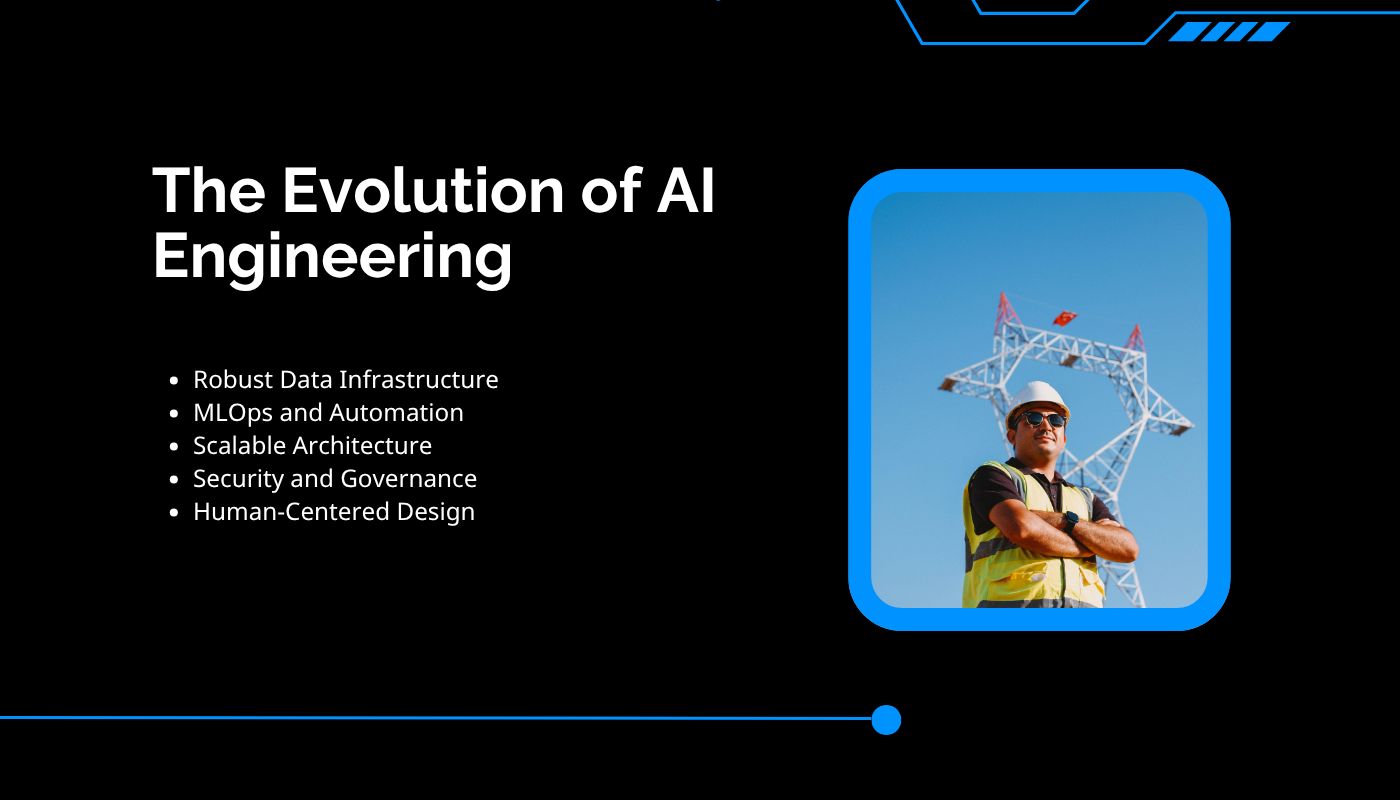
From Models to Systems: The Evolution of AI Engineering
In the early wave of AI adoption, most organizations built isolated models or small pilots: churn prediction algorithms, basic chatbots, or demand-forecasting models. While these early projects demonstrated potential, they rarely translated into production-level results because they lacked:
- End-to-end data pipelines
- Continuous monitoring and retraining
- Integration with existing systems
- Clear business alignment
Product-grade AI systems fix this gap. They are engineered with:
1. Robust Data Infrastructure
AI thrives on high-quality, well-governed data. Modern AI systems rely on data lakes, feature stores, event-stream pipelines, and real-time ETL processes. This ensures that models are trained and run on consistent, timely data.
2. MLOps and Automation
Just as DevOps revolutionized software delivery, MLOps is essential for AI scale. Automation frameworks manage model training, deployment, versioning, rollback, testing, and monitoring—turning AI into a reliable operational asset.
3. Scalable Architecture
Cloud-native design, containerization, microservices, and vector databases enable AI systems to handle millions of queries and large-scale inference workloads with minimal latency.
4. Security and Governance
Responsible AI usage requires guardrails: access controls, data privacy compliance, prompt filtering, audit trails, and bias-detection pipelines.
5. Human-Centered Design
AI becomes valuable only when people can use it effectively. Interfaces, workflows, and decision-support layers must be intuitive, trustworthy, and aligned with how teams operate.
These engineering considerations turn what could be a fragile model into a reliable system that businesses can use every day.
Cross-Industry Adoption: Real Business Problems, Real Impact
Product-grade AI systems are generating value across virtually every sector. While the use cases differ, the underlying pattern is the same: AI is embedded into mission-critical processes to deliver measurable outcomes.
Below are some of the most transformative cross-industry applications.
1. Manufacturing: Predictive Intelligence on the Factory Floor
Modern factories are becoming intelligent ecosystems. AI-powered systems monitor equipment health, analyze sensor streams, and detect anomalies before failures occur.
Impact:
- 30–50% reduction in unplanned downtime
- Lower maintenance costs
- Improved worker safety
- Higher yield and production quality
These systems require sophisticated engineering—edge computing, low-latency inference, secure IoT pipelines—to function reliably in demanding industrial environments.
2. Retail & eCommerce: Personalization at Scale
Product-grade recommendation engines now use real-time behaviors, historical data, and contextual signals to generate dynamic product rankings.
Impact:
- Higher conversion rates
- Larger basket sizes
- Customer retention improvements
- Optimized pricing and inventory
Retailers also use AI for supply-chain forecasting, fraud detection, customer service bots, and automated merchandising.
3. Financial Services: AI for Trust, Speed, and Risk Reduction
Banks and insurers have some of the most mature AI infrastructures due to strict regulations and high transaction volumes.
Key systems include:
- Fraud detection with real-time anomaly detection models
- Credit scoring via explainable ML
- Claims automation powered by computer vision
- Intelligent customer service and financial advisory assistants
Impact:
- Lower fraud losses
- Faster approvals and payouts
- Reduced call-center load
- Better risk evaluation
These systems require rigorous explainability, governance, and auditability—core traits of product-grade AI.
4. Healthcare: Precision and Predictive Care
From radiology to hospital operations, product-grade AI systems are reshaping diagnostics and patient care.
Examples include:
- Imaging models for cancer and disease detection
- Predictive tools for patient deterioration
- AI-powered medical documentation assistants
- Supply chain and staffing optimization
Impact:
- Improved clinical accuracy
- Reduced physician burnout
- Better patient outcomes
- Lower operational costs
Healthcare demands the highest level of model reliability, security, and ethical safeguards—pushing AI engineering standards even higher.
5. Logistics & Transportation: The AI-Optimized Network
AI is behind route optimization, fleet management, fuel efficiency, demand forecasting, and even autonomous vehicle perception.
Impact:
- Faster delivery times
- Reduced fuel and labor costs
- Better route planning
- Higher on-time performance
These systems often run on real-time streaming data, requiring robust architecture and continuous monitoring.
The Business Case: Why Product-Grade AI Wins
Organizations investing in robust, scalable AI systems consistently see better outcomes than those experimenting with ad hoc prototypes.
1. Reliability = Trust
Employees and customers adopt systems they can depend on. Product-grade AI reduces false alarms, downtime, and unpredictable behavior.
2. Scalability = Efficiency
Whether serving thousands or millions of users, engineered AI can grow with demand without losing performance.
3. Integration = Real Workflow Value
AI must seamlessly plug into CRM systems, ERP platforms, data lakes, communication tools, and operational dashboards. Integration is where business value becomes visible.
4. Governed AI = Risk Reduction
Compliance failures and biased models can be costly. Product-grade systems embed governance from the start, ensuring safe deployment.
5. Continuous Improvement = Competitive Advantage
With automated retraining, monitoring, and fine-tuning, these systems get smarter over time—compounding the ROI.
The Future: Intelligence as a Core Layer of the Enterprise
As AI continues maturing, engineering intelligence will become a standard capability in every organization. We are moving toward a future where:
- Every workflow has an AI co-pilot
- Every customer interaction is context-aware
- Every decision is supported by predictive insights
- Every system adapts automatically to new data
Product-grade AI systems make this possible. They are robust enough for mission-critical environments, flexible enough to evolve, and intelligent enough to generate real business impact.
Conclusion
The next era of AI isn’t defined by bigger models—it’s defined by better engineering. The organizations that win will be those that build AI systems like products: scalable, secure, integrated, and relentlessly focused on solving business problems.
Across industries, engineered intelligence is transforming operations, unlocking new revenue, and reshaping customer experience. As AI moves deeper into the fabric of global business, building product-grade systems is not just an advantage—it is essential for leadership in the modern digital economy.