In an age where data drives innovation, agility, and customer experience, organizations can no longer afford to rely on legacy systems for their analytics and decision-making processes. Enter the Modern Data Stack (MDS) — a cloud-native, modular, and scalable architecture designed to empower teams with fast, reliable, and actionable insights. At Scalex, we’ve reimagined data engineering with a cloud-first mindset to help enterprises evolve from siloed data operations to a unified, intelligent ecosystem.
This blog explores the Scalex approach to building a modern data stack, addressing common challenges, core components, and strategic benefits that define cloud-native data engineering today.
The Case for Modernization
Traditional data architectures — often on-premises, monolithic, and maintenance-heavy — struggle with today’s data volumes, velocity, and variety. Batch processes, ETL bottlenecks, and lack of real-time insights severely limit business agility. With the rise of cloud computing, distributed data sources, and AI-driven decision-making, a shift toward a modern data architecture is not optional — it’s imperative.
At Scalex, we start with a simple principle: make data fast, accessible, and trusted across the enterprise. But how do we get there?
What is the Modern Data Stack?
The modern data stack refers to a cloud-native suite of tools and platforms that manage data ingestion, storage, transformation, orchestration, governance, and visualization — often decoupled but seamlessly integrated. A typical stack includes:
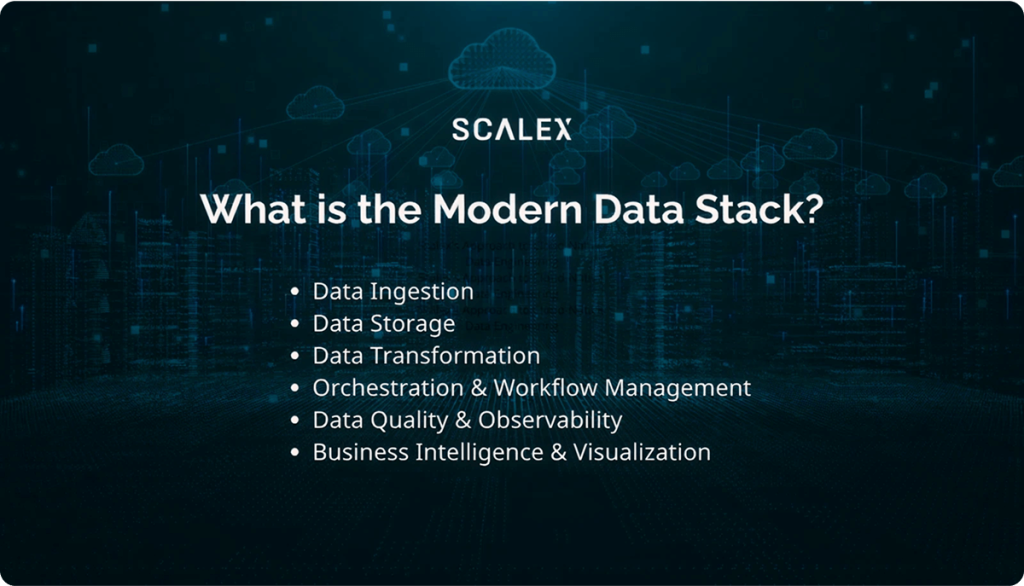
- Data Ingestion: Real-time and batch pipelines from APIs, apps, databases, IoT, and SaaS tools.
- Data Storage: Cloud data lakes and warehouses (e.g., Amazon S3, Snowflake, BigQuery, Databricks).
- Data Transformation: ELT (Extract-Load-Transform) pipelines, typically managed via tools like dbt.
- Orchestration & Workflow Management: Tools like Apache Airflow or Dagster for task scheduling and monitoring.
- Data Quality & Observability: Monitoring pipelines, schema drift, and anomaly detection.
- Business Intelligence & Visualization: Tools like Looker, Power BI, or Tableau for dashboards and reporting.
What makes it “modern” is not just the tooling, but the cloud-native, scalable, real-time, and API-driven approach to data.
The Scalex Approach: Engineering for the Cloud-First Era
At Scalex, we take a strategic and modular approach to building modern data stacks for our clients — from startups to Fortune 500s. Here’s how we differentiate:
1. Cloud-Native by Design
We design data architectures ground-up for cloud platforms like AWS, GCP, and Azure — leveraging their managed services (e.g., Glue, BigQuery, Redshift, or Dataflow) for cost efficiency, scalability, and reduced operational overhead.
This approach not only accelerates time-to-value but also ensures elasticity — you scale up or down with demand, paying only for what you use.
2. ELT over ETL: Shift Left on Transformation
Traditional ETL pipelines transform data before it’s loaded — often resulting in complexity and tight coupling. In contrast, we promote ELT, loading raw data into cloud data warehouses and transforming it using SQL-based tools like dbt. This separation of concerns enhances transparency, governance, and agility.
3. Modular, API-First Architecture
Gone are the days of end-to-end monolithic pipelines. Scalex enables composable data architectures, where each component can evolve independently. For example, switching from Kafka to Kinesis for streaming, or integrating new observability tools, happens without disrupting the stack.
Every layer — from ingestion to consumption — is driven by APIs, allowing easy integration with data science, machine learning, and business applications.
4. Infrastructure as Code (IaC)
Automation and repeatability are cornerstones of our methodology. We provision data infrastructure using Terraform, Pulumi, or CloudFormation, ensuring version control, auditability, and easy rollback across environments.
This reduces manual configuration errors and enables rapid deployment across dev, test, and prod.
5. Data Governance and Security Embedded
In modern architectures, data governance is not an afterthought. Scalex integrates tools like Apache Ranger, Atlan, or Collibra to manage access control, metadata, data lineage, and compliance (e.g., GDPR, HIPAA).
We implement role-based access, encryption at rest and in transit, and automated data classification from day one.
6. Observability and Reliability
Data pipelines fail. The difference lies in how fast you can detect, debug, and resolve issues. We embed observability tools (e.g., Monte Carlo, Databand, OpenLineage) for real-time monitoring, data drift detection, and anomaly alerting — ensuring high data reliability and trust.
Real-World Outcomes
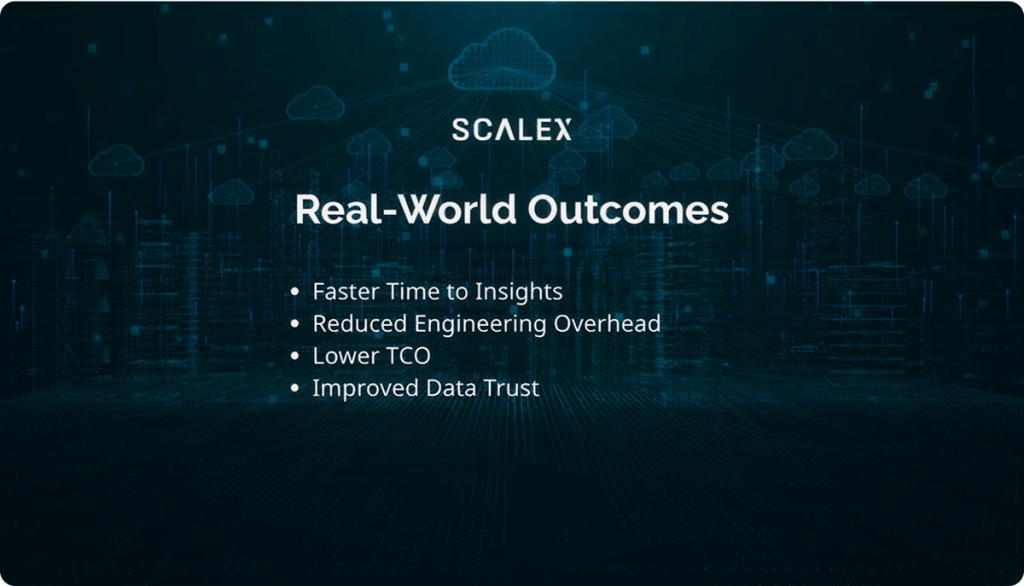
Faster Time to Insights
With event-driven architectures and real-time pipelines, business users and data scientists can access insights in seconds, not hours or days.
Reduced Engineering Overhead
Using managed services and IaC, we reduce setup and maintenance time by 40–60%, letting your data team focus on delivering value, not fighting fires.
Lower TCO
By choosing serverless and pay-as-you-go services, our clients save up to 50% on infrastructure costs, while scaling seamlessly as data grows.
Improved Data Trust
Data observability, governance, and version-controlled transformations ensure data consumers trust what they see.
The Future: AI-Ready Data Stacks
With the rise of GenAI and ML applications, your modern data stack must evolve into a feature store” + “real-time feedback loop model. Scalex is pioneering the next wave of AI-ready data platforms, integrating with vector databases, streaming analytics, and automated feature pipelines to support personalization, predictive analytics, and autonomous decisioning.
Final Thoughts
The journey to the modern data stack isn’t just about tools — it’s about a mindset shift. A shift from monoliths to modularity. From batch to real-time. From reactive to proactive data cultures.
At Scalex, we’re building this future every day — one cloud-native, intelligent, and resilient data stack at a time.
Want to modernize your data infrastructure? Let’s talk — we’ll show you how Scalex can transform your data foundation for the decade ahead.