In today’s digital economy, growth is no longer a distant milestone, it’s an expectation. Products can go from a handful of users to millions in a matter of months. While growth is exciting, it exposes weaknesses in systems that weren’t designed to scale. Many platforms don’t fail because of lack of demand; they fail because their engineering foundations can’t keep up.
Designing scalable digital platforms is not about overengineering for a hypothetical future. It’s about applying the right engineering principles early so growth feels incremental, not catastrophic. This article explores the core principles that enable high-growth products to scale reliably, efficiently, and sustainably.
What Does Scalability Really Mean?
Scalability is often misunderstood as “handling more traffic.” In reality, it’s broader and more nuanced. A scalable platform can:
- Handle increasing load without disproportionate increases in cost
- Adapt to new features, use cases, and markets
- Recover gracefully from failures
- Enable teams to move fast without stepping on each other
True scalability is as much about organizational velocity and system resilience as it is about raw performance.
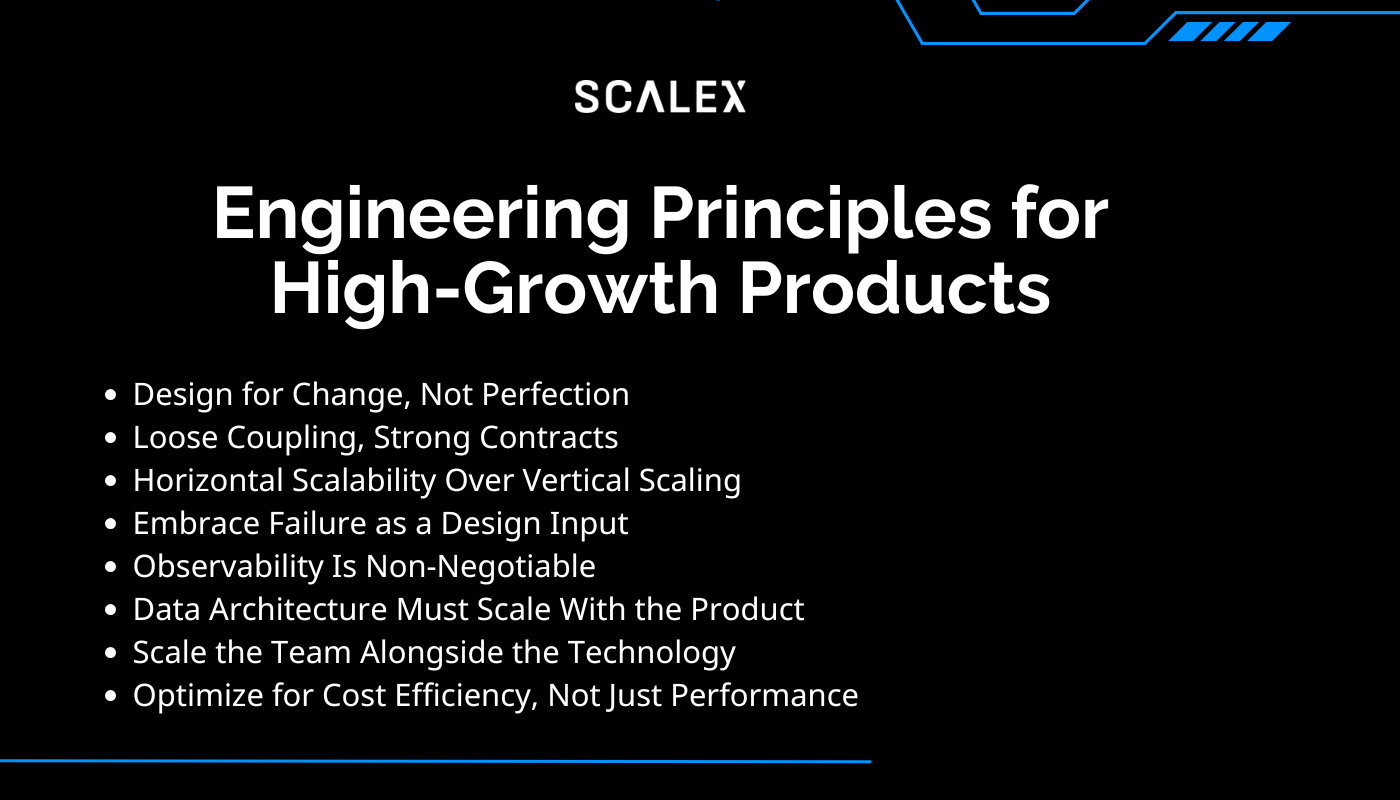
Principle 1: Design for Change, Not Perfection
High-growth products evolve constantly—features pivot, user behavior shifts, and business models adapt. Systems designed for a “final” state rarely survive first contact with reality.
Key practices:
- Favor modular architectures over tightly coupled systems
- Avoid hard-coded assumptions about scale, geography, or usage patterns
- Treat requirements as fluid, not fixed
- Scalable platforms embrace change as a first-class constraint.
Principle 2: Loose Coupling, Strong Contracts
As systems grow, dependencies become the biggest source of fragility. Loose coupling allows teams and services to evolve independently, while strong contracts ensure reliability.
How to apply this:
- Use clear APIs and schemas between services
- Minimize shared databases or global state
- Make service boundaries explicit and intentional
This approach reduces blast radius when failures occur and enables parallel development at scale.
Principle 3: Horizontal Scalability Over Vertical Scaling
Adding more power to a single machine (vertical scaling) has hard limits. Adding more machines (horizontal scaling) enables near-linear growth when designed correctly.
Design implications:
- Build stateless services wherever possible
- Externalize session state and caching
- Design workloads to be distributable
Platforms that scale horizontally are inherently more resilient and cost-efficient over time.
Principle 4: Embrace Failure as a Design Input
At scale, failure is not an edge case—it’s normal. Network partition, instances crash, and dependencies slow down. The question is not if failure will happen, but how your system behaves when it does.
Engineering for failure means:
- Implementing timeouts, retries, and circuit breakers
- Designing graceful degradation paths
- Avoiding single points of failure
Resilient systems fail predictably and recover automatically.
Principle 5: Observability Is Non-Negotiable
You cannot scale what you cannot see. As systems grow more complex, traditional logging is no longer enough.
Scalable platforms invest in:
- Structured logging with correlation IDs
- Metrics that reflect real user experience
- Distributed tracing across services
Observability turns debugging from guesswork into engineering.
Principle 6: Data Architecture Must Scale With the Product
Data often becomes the bottleneck in high-growth platforms. Poor early decisions around schemas, queries, or storage models can severely limit future growth.
Best practices include:
- Separating transactional and analytical workloads
- Designing schemas for access patterns, not convenience
- Planning for partitioning and data locality early
Scalable data systems are designed for growth in both volume and complexity.
Principle 7: Scale the Team Alongside the Technology
Technical scalability without team scalability leads to burnout and bottlenecks. Engineering systems should empower teams, not slow them down.
Organizational enablers:
- Clear ownership of services and components
- Automation in testing, deployment, and infrastructure
- Consistent engineering standards and tooling
High-growth products require platforms that scale both code and people.
Principle 8: Optimize for Cost Efficiency, Not Just Performance
At scale, small inefficiencies become massive expenses. Designing with cost-awareness from the start prevents painful rewrites later.
Strategies include:
- Autoscaling based on real demand
- Tiered storage and caching strategies
- Regular cost and performance reviews
Scalable systems balance performance, reliability, and economics.
Final Thoughts
Designing scalable digital platforms is not about predicting the future—it’s about preparing for it. The most successful high-growth products are built on engineering principles that value adaptability, resilience, and clarity over premature optimization.
Scalability is not a single feature or architecture choice. It’s a mindset embedded in every design decision, from system boundaries to team workflows. When done right, growth becomes a challenge to manage—not a crisis to survive.