The pharmaceutical industry has always faced significant challenges in the lengthy, costly, and complex process of drug discovery. Traditionally, it involved meticulous and exhaustive searches through extensive chemical libraries to identify molecules with the potential to treat illnesses. However, the advent of generative AI is transforming this landscape by accelerating the development process, enhancing the drug discovery pipeline, and opening new avenues for innovative medications. The introduction of Agentic AI further refines this process by allowing autonomous action in specific stages, enabling faster and more autonomous decision-making throughout the pipeline.
In this blog, we delve into how generative AI and Agentic AI are revolutionizing each phase of drug discovery, examine their real-world applications, and discuss the potential challenges and benefits they bring to the table.
What Role Does Generative AI Play in Each Phase of the Drug Discovery Process?
Generative AI significantly impacts every stage of drug discovery, from initial research to post-market monitoring, by enhancing efficiency and reducing time frames. Meanwhile, Agentic AI empowers systems to make autonomous decisions during these phases, enhancing adaptability and speed.
Target Identification and Validation
Lead Discovery
Generative AI models, such as GANs (Generative Adversarial Networks) and RNNs (Recurrent Neural Networks), assist in generating new molecular structures. These models predict binding affinities and pharmacological properties, accelerating the identification of lead compounds. Integrating Agentic AI, these systems can automatically assess and prioritize these leads based on real-time data, streamlining the candidate selection process.
Lead Optimization
Generative AI tools suggest chemical modifications to enhance therapeutic efficacy and safety. This is enhanced by Agentic AI, which autonomously iterates on optimization strategies, continuously refining candidates to meet therapeutic goals without manual intervention.
Preclinical Testing
During preclinical testing, generative AI evaluates toxicity, safety, and efficacy across large datasets. Agentic AI facilitates autonomous adjustments to testing protocols based on predictive outcomes, optimizing resource allocation and minimizing unnecessary experimentation.
Clinical Trials
In clinical trials, AI is pivotal for designing study protocols, recruiting suitable candidates, and analyzing patient data in real-time to identify safety issues and treatment effectiveness. Agentic AI systems can autonomously adapt trial parameters based on evolving data, ensuring responsive and dynamic trial management.
Regulatory Review
Generative AI expedites regulatory submissions by processing complex data for thorough evaluations. Agentic AI enables autonomous data synthesis and submission preparation, ensuring regulatory processes are efficient and compliant.
Working of Generative and Agentic AI in Drug Discovery
Generative AI leverages sophisticated algorithms and machine learning to sift through data, producing novel therapies and drug candidates. Agentic AI, on the other hand, allows for autonomous, task-specific decision-making, dynamically adapting to new information and optimizing processes without human input. This synergy accelerates timelines and enhances precision across the drug discovery landscape.
Use Cases of Generative AI in Drug Discovery
1. Molecule Simulations
Generative AI models, such as GANs (Generative Adversarial Networks) and RNNs (Recurrent Neural Networks), assist in generating new molecular structures. These models predict binding affinities and pharmacological properties, accelerating the identification of lead compounds. Integrating Agentic AI, these systems can automatically assess and prioritize these leads based on real-time data, streamlining the candidate selection process.
2. Optimization of Drugs
AI models suggest and evaluate alterations to enhance drugs’ efficacy, safety, and bioavailability. Agentic AI autonomously manages these optimization processes, quickly iterating through potential modifications to identify the most promising candidates.
3. Virtual Screening
Generative AI refines the virtual screening process by predicting drug-target interactions. Integrated with Agentic AI, these models autonomously filter large chemical libraries to efficiently identify promising drug candidates.
4. Compound Library Expansion
Generative AI predicts modifications to enhance characteristics of existing compounds. Agentic AI autonomously evaluates these predictions, continuously enriching the compound library with viable new options.
5. Finding Biomarkers
Agentic AI assists in the autonomous discovery of biomarkers, sifting through complex datasets to uncover new diagnostic and therapeutic biomarkers.
Working of Generative and Agentic AI in Drug Discovery
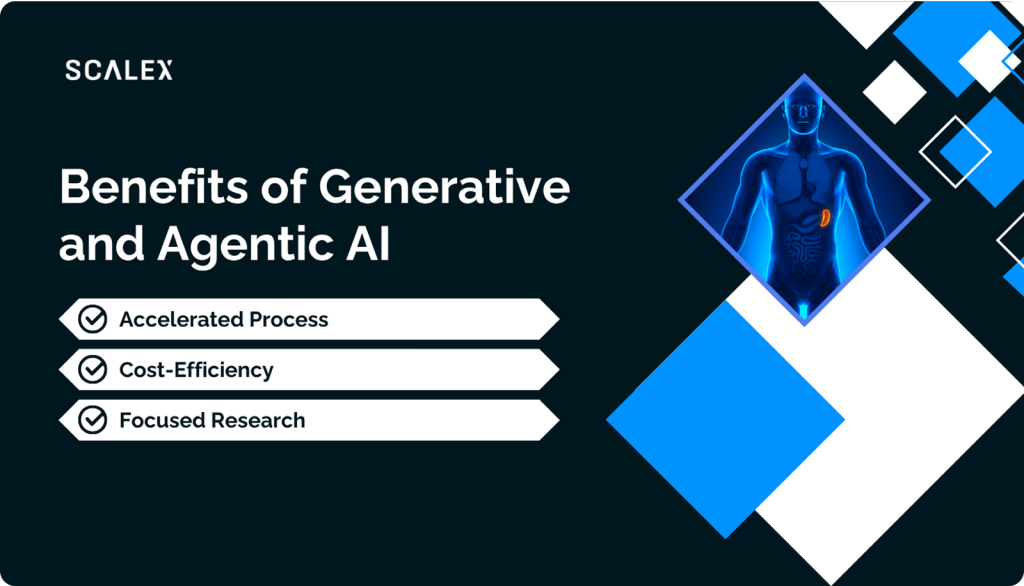
Accelerated Process
These AI technologies expedite the identification of promising drug candidates by automating repetitive tasks and decision-making, significantly reducing the time from discovery to clinical trials.
Cost-Efficiency
The integration of generative and Agentic AI minimizes costly laboratory work and enhances successful candidate identification, thereby reducing overall research and development expenses.
Focused Research
AI facilitates targeted research efforts, bringing new hope and therapeutic possibilities for hard-to-treat conditions and rare diseases through autonomous data-driven insights.
Challenges in Drug Development Posed by Generative AI
Despite its promise, generative AI faces challenges such as the need for high-quality data, ethical and privacy concerns, and the risk of biased outputs from AI models trained on limited datasets. Agentic AI must also be carefully managed to ensure reliable and responsible autonomous decision-making.
Conclusion
Generative AI, powered by autonomous Agentic AI systems, is revolutionizing the landscape of drug discovery. From molecular design to clinical trials, these technologies are embedding efficiency, cost-effectiveness, and innovation into pharmaceutical development processes. Embracing these advances will unlock new potential, enabling unprecedented discoveries and redefining possibilities for patient care worldwide.
At Scalex, we stand at the forefront of this transformation, offering comprehensive gen ai consulting and Agentic AI services that accelerate your drug discovery process while ensuring robust, data-driven outcomes. Contact our team today to harness the full potential of AI innovation and redefine your drug development pipeline. Together, we can create the therapies of tomorrow, today.