Artificial intelligence is no longer just about understanding language—it’s now about taking action. The evolution of AI models has ushered in a new era where systems don’t just respond to commands but carry them out. At the core of this shift are two transformative AI frameworks: Large Language Models (LLMs) and Large Action Models (LAMs).
Whether you’re a product manager designing intelligent software, a startup founder exploring automation, or a developer crafting AI-enabled tools, knowing the difference between LLMs and LAMs is essential to ensure your project’s success.
In this guide, we’ll unpack the fundamentals of both technologies, explore their strengths and limitations, and help you identify which AI model aligns best with your business goals for leveraging llm development services.
Understanding the Foundations
What is an LLM?
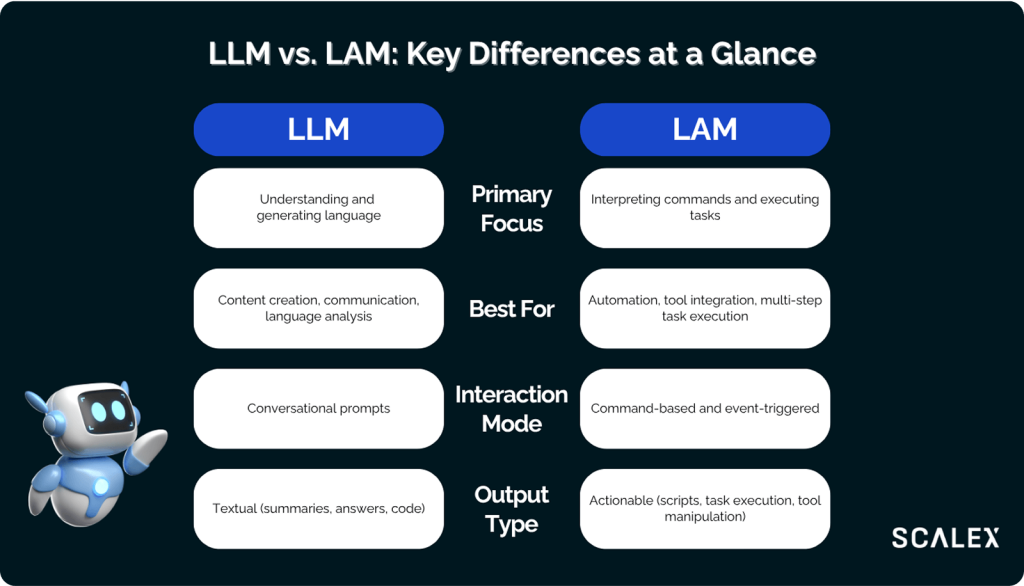
LLMs (Large Language Models) are AI systems trained on vast datasets consisting of human language. Their primary purpose? Understanding and generating text. From writing blog posts and translating languages to summarizing research papers and answering complex queries—llm agents are the linguistic powerhouses of AI.
These models learn language patterns through deep neural networks and are highly effective in any context where interpreting or generating natural language is essential.
What is a LAM?
LAMs (Large Action Models), in contrast, go beyond text. These models are designed not just to understand instructions but to act on them. Whether it’s navigating a user interface, executing code, submitting forms, or integrating with APIs—LAMs are built for actionable intelligence.
Think of them as smart agents that combine reasoning with automation, offering a new level of capability in task execution and decision-making.
LLM vs. LAM: Key Differences at a Glance
Advantages and Challenges
LLM Strengths
- Advanced Text Understanding: Ideal for tasks involving summarization, translation, and ideation.
- Pre-Trained Models: Ready-to-use solutions like GPT-4 and Claude reduce time to deploy.
- Domain Adaptability: Easily fine-tuned for legal, healthcare, finance, and more.
- Strong Ecosystem: Tools like LangChain and LlamaIndex simplify integration.
LLM Limitations
- High Resource Usage: Demands significant computing power for training and deployment.
- Limited Reasoning: May generate plausible but inaccurate or biased responses.
- Static Outputs: Cannot take actions; confined to passive text generation.
LAM Strengths
- Task Automation: Executes real-time commands, from filling out forms to controlling devices.
- Multimodal Understanding: Processes text, images, and interfaces for greater flexibility.
- Context Awareness: Remembers past actions and adapts as situations evolve.
- Ideal for Agents & Robotics: Great fit for autonomous workflows and real-world systems.
LAM Limitations
- Language Generation Trade-offs: Not as strong in generating nuanced, human-like text.
- Deployment Complexity: Requires more infrastructure and integration planning.
- Security Risks: Requires rigorous permissions and safety controls due to its ability to take action.
When to Use LLM vs. LAM
Choose LLMs When:
- Your project involves content generation, text analysis, or code suggestion.
- You need a conversational agent or chatbot to provide human-like interactions.
- You’re analyzing unstructured text data for insights.
- Language fluency and tone matter more than action execution.
Choose LAMs When:
- You want AI that can act, not just respond—automating tasks or navigating interfaces.
- Your application needs multi-step planning and real-time task execution.
- You’re building digital agents, process automation tools, or robotics systems.
- Contextual memory and dynamic decision-making are essential.
Looking Ahead: The Future of AI Models
LLMs and LAMs are not competitors—they’re collaborators in the larger AI ecosystem. LLMs will continue evolving with deeper contextual understanding, better reasoning, and lower bias. LAMs, on the other hand, will take AI beyond chat—into environments where it thinks, plans, and acts.
Eventually, we’ll likely see hybrid models where the boundaries between LLMs and LAMs blur, forming the next generation of AI agents that are both intelligent and operationally capable.
Your Next Step: Build Smarter AI with Scalex
Ready to bring intelligent automation or AI-powered conversation into your product?
Scalex specializes in building customized AI solutions using both LLMs and LAMs. Whether you need a smart chatbot, looking for llm development services, an autonomous agent, or an end-to-end automation pipeline, we help turn your ideas into scalable, secure, and efficient AI applications. Contact us today!